

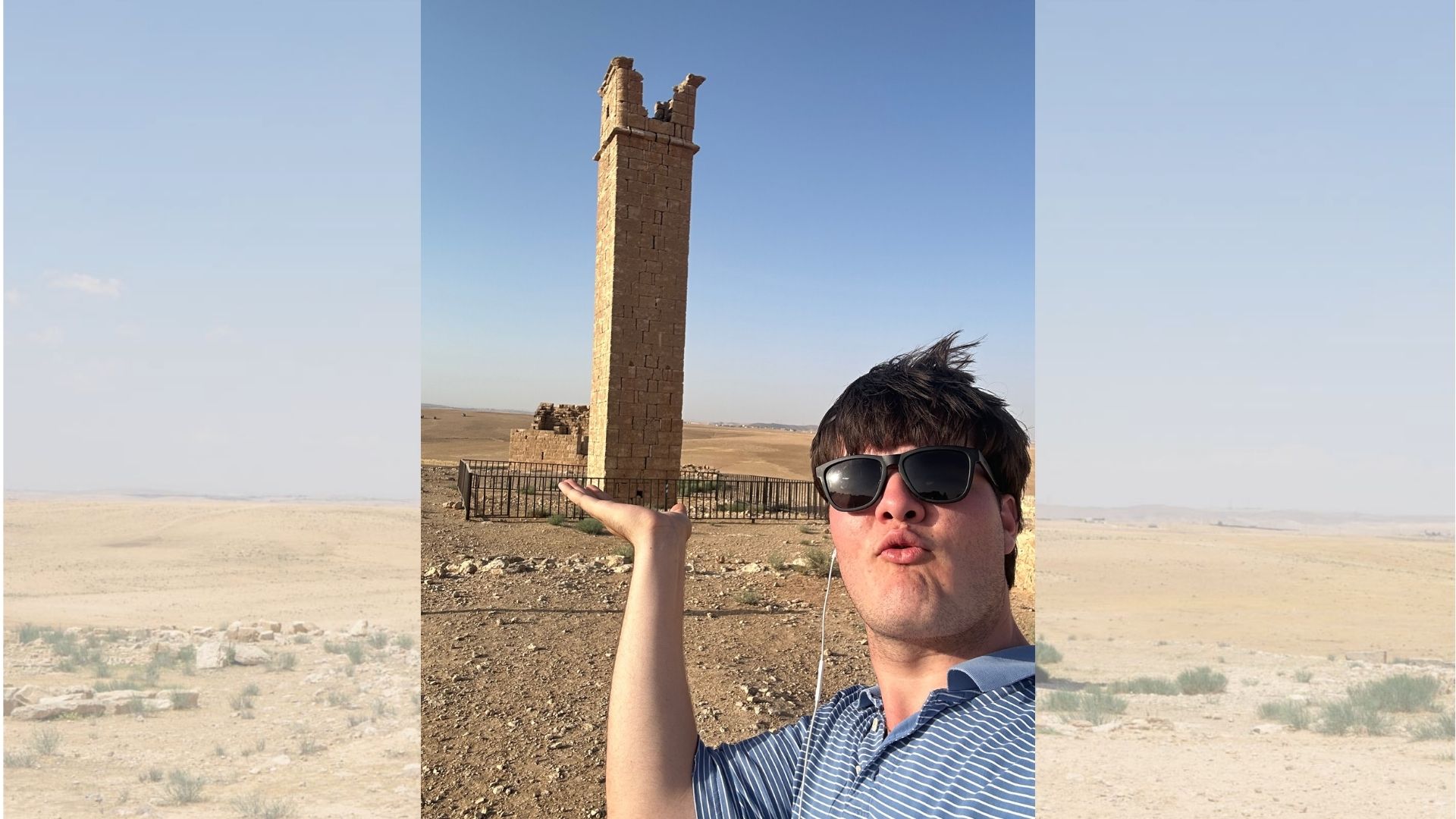
This new Q&A series highlights the range of work from students pursuing the minor in medieval studies, an interdisciplinary study of the Middle Ages in a global perspective. This spotlight is on Dan Kasier ’26, a history major pursuing minors in Medieval Studies and Hellenic Studies.
What got you interested in medieval studies?
I would be remiss if I did not mention that my first contact with anything medieval was in my high school’s history sequence, taught by Dr. James Lothian and Mr. Joe Lechner, where we studied the High Middle Ages in great depth. For the most part, my interest in medieval studies found its genesis in these earlier years.
I was first attracted to Princeton’s medieval studies program in my freshman fall, while taking Professor Anthony Grafton’s HIS 211, “Europe from Antiquity to 1700.” Although it was not an official Medieval Studies course, we covered topics ranging from Ss. Perpetua & Felicity to the life of Peter Abelard and Heloise, and, through this, I developed a deep desire to continue on. I then found myself taking as many medieval courses as I could “get my hands on,” learning from Professor Bill Jordan, Professor Jack Tannous, Professor Helmut Reimitz, and Professor Simone Marchesi. I find great satisfaction in studying medieval history and literature, because many of the institutions, beliefs, and traditions of our modern world find their origins in the late antique and medieval world.
What has been your favorite MED course so far and why? Cross-listed courses count!
My favorite MED course so far has been either HIS 344: Civilization of the High Middle Ages, taught by Professor Jordan, or HIS 437: Law After Rome, taught by Professor Reimitz. Both courses intensively examined aspects of medieval culture and society, and the instructors were both absolutely stellar.
Tell us about your independent work (topic or title) for the minor.
My senior thesis, on the Military Order of Calatrava in Medieval Spain, largely came out of my junior paper on the early Reconquista and the formation of the Kingdom of Asturias. My thesis is a textual history, tracing the development of the military orders and crusading spirituality in the Reconquista through Papal decretals, Canon law, and Chronicles. I love my topic, it keeps me up at night.
What’s one interesting or surprising thing that you’ve found during your independent research?
The Cistercian Order was largely—and almost solely—responsible for the formation and development of the Spanish military orders.
What is one thing you think everyone should know about the Middle Ages?
Everyone should know that it was not the “Dark Ages,” as the period is commonly mislabeled and misunderstood.
Is there anything else you’d like to mention about your experience in the MED minor?
The medieval studies program has been the most welcoming and most fascinating group I’ve encountered on campus, with scholars from wide-ranging backgrounds and course offerings that knock your socks off. I wholeheartedly endorse the medieval studies program for anyone interested!
Visit our website to learn more about the Program in Medieval Studies and explore the undergraduate minor. Students can apply as early as sophomore spring. Interested students can reach out to Anna D’Elia, program manager, with questions.